CDL School College Station TX
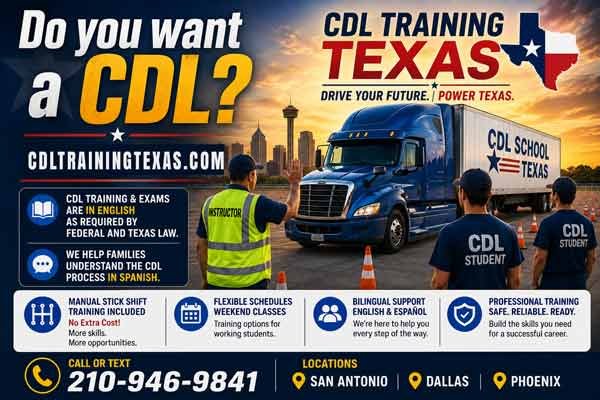
Class A CDL training for students in College Station, Bryan and the Brazos Valley. Weekend classes, flexible schedules, personal support, and Manual Stick Shift Training included at no extra cost.
¡HABLAMOS ESPAÑOL TAMBIÉN!
We have a bilingual trainer. Training is conducted in English, but
if there is something you do not understand, our trainer can
explain it in Spanish to help you understand the material and keep
preparing in English.
CALL OR TEXT US TODAY
Visit CDLTRAININGTEXAS.COMA CDL Is a Trade, Not Another Card in Your Wallet
Read this part before you decide whether now is a good time.
Almost nobody starts CDL training in a good month. There is a shift to cover, rent due on the first, a kid who has to be picked up at three, a truck payment, a family member who needs help. The clear, quiet month where everything lines up and the money is already sitting there does not usually arrive on its own. People wait for it anyway, and a year later they are in the same job, earning the same money, still saying they are going to look into it.
A commercial driver’s license is a skilled trade. It is not a card you put in your wallet and forget about. It is a set of skills you own — backing a trailer, shifting a manual transmission, inspecting a vehicle properly, reading traffic far enough ahead to stay out of trouble. Those skills go with you from one company to the next. They do not disappear when a business closes or a manager changes his mind about your department.
It also takes real work to learn. That is the whole point. Anything you can learn in a weekend does not pay well, precisely because anyone can do it. Learning to handle a combination vehicle safely takes practice, repetition, and a trainer who is honest with you about what you are doing wrong. Most students are awkward with the clutch and the mirrors at first. Every one of them was. That is not a sign you are not cut out for it — it is what the first week looks like.
This is exactly why weekend classes and flexible training schedules matter. You do not have to quit your job to start. The theory portion is online, so you can study from your phone at night, on a break, or on a Sunday morning before anyone else is awake. The driving and skills practice happens on a schedule built around people who already have responsibilities. You do not need to have your whole life reorganized before you begin. You need a starting date and the willingness to show up for it.
If you are working toward being more independent, supporting your family, or moving into transportation as a long-term career, this is a real, practical path with a real skill at the end of it. What we can tell you honestly is what the training covers, what it costs, what the tests require, and what you will have to do on your side. The rest is up to how you show up.
TAKE THE FIRST STEP TODAY
Call or Text 210-946-9841 FILL OUT THE CONTACT FORMAsk your questions first. You are not committing to anything by calling, and there is no cost to find out what your next step would be.
CDL Training for College Station, Bryan & the Brazos Valley
Brazos County sits in the middle of the Texas Triangle, away from the interstates but connected to all of them — which is exactly why so much of what moves through this area moves by truck.
State Highway 6 is the spine of the region. It runs north and south straight through Bryan-College Station, carries the freight that supplies the whole area, and is designated as a hurricane evacuation route — which means local drivers occasionally work a road carrying far more traffic than a normal day. TxDOT has an expansion project underway along SH 6 through the area, so work-zone driving is part of everyday life here, not a rare event. A driver trained in this region learns those habits early.
Commercial drivers are the reason a community like this one keeps running. Grocery shelves, fuel tanks, construction sites, feed stores and campus deliveries all depend on someone with a CDL arriving safely and on time. That is why the training matters as much as the license: this region has interstate-speed traffic on SH 6, farm roads with no shoulder, students and pedestrians in town, and severe Texas weather — all in the same working day.
CDL SCHOOL COLLEGE STATION TX PRICE IS $2300
🌟 It’s Your Time to Shine! 🌟 Don’t let this extraordinary opportunity slip through your fingers. Visit our website at www.cdlschooltexas.com or reach out to us right away via phone or WhatsApp using the following numbers: 📍 Texas, Pasadena: 832-706-6368 📍 Fort Worth: 817-789-9823 📍 San Antonio and Austin: 210-946-9841
🤩 Your CDL License has the power to transform your life. 🌠 Don’t miss the chance to pursue your dreams. 🌠
Call us today for more information. 📲
CDL SCHOOL COLLEGE STATION TX PRICE IS $2300
Yes, it’s only $2300 PAY IN PAYMENTS for CDL training in College Station, TX. Our training is affordable, with a flexible schedule that even includes weekends. We offer classes for both manual and automatic trucks in classes “A” and “B.” For just $2,300 payable in installments, you’ll receive comprehensive training that covers:
🚛 ELDT 20 Hours Government Requirement 📖 Reading Test Training in Spanish and English 🚚 Air Brakes In-Cab Training 🧐 Pre-Trip Inspection Training 🚀 Maneuvering Skills in the Truck 🚛 Truck for Testing 🎯 We Provide the Truck with 6 Tries (Practically Guaranteed Success) 💼 Job Placement Assistance 🏅 Endorsements
Your journey to success starts here! 🚀 Don’t miss out on this opportunity to change your life.
What Your $2,300 CDL Training Includes
Learn to operate a commercial vehicle and build the knowledge and practical skills you need for your Class A CDL. Ask us about current schedules, payment options and enrollment.
Built Around Your Work Week
Weekend classes and flexible training schedules are designed for students balancing shift work, family and other responsibilities.
Free Extra Courses
No CostAvailable to our students who need them. Getting the license is one thing — building the life around it is another.
Citizenship Prep
Civics questions and interview practice for the naturalization test.
English Pills for Truckers
Short lessons on the English you actually use at the dock and on the road.
+ more support courses — ask us what you need
Understanding Your CDL
Before you spend money on training, it helps to understand what you are actually working toward. Here is the plain-English version.
What is a CDL?
A Commercial Driver’s License is a special license required to operate large or heavy commercial vehicles, vehicles carrying certain hazardous materials, and vehicles designed to carry a large number of passengers. It exists because a loaded commercial vehicle is not a bigger car. It weighs many times more, takes much longer to stop, has large blind spots, and has a trailer that does not follow the same path as the tractor through a turn.
That is why a CDL requires more than a regular driving test. You have to show that you understand the vehicle’s systems, can inspect it and identify defects, can control it at low speed in tight spaces, and can drive it safely in real traffic. The license is the state’s confirmation that you demonstrated those things.
Class A CDL
A Class A CDL is the license class associated with combination vehicles — generally a truck-tractor pulling a trailer, where the combined weight rating and the trailer’s weight rating meet the thresholds set in federal and state rules. In practical terms, this is the class most students think of when they picture over-the-road trucking: a tractor-trailer, a flatbed, a dry van, a tanker, a car hauler.
Class A is also the broadest of the license classes. Because it covers combination vehicles, a properly licensed Class A holder is generally able to operate many smaller commercial vehicles as well, subject to the endorsements and restrictions on the license. Exact privileges depend on current federal and Texas rules, the vehicle, and what is printed on your license — always confirm with the Texas Department of Public Safety.
The CDL Training Process, Step by Step
Every student asks the same first question: what actually happens, and in what order? This is the sequence.
- 1 Eligibility Age, immigration or citizenship status, driving record, and a DOT medical examination. Age requirements differ for driving within Texas versus across state lines. Confirm current rules before you plan anything.
- 2 Commercial Learner’s Permit You study for and pass the written knowledge tests to get your CLP. Federal rules require you to hold the CLP for a minimum period before you can take the CDL skills test.
- 3 ELDT Theory The required Entry-Level Driver Training theory curriculum, completed with a registered training provider. Ours is online, so you study from your phone.
- 4 Pre-Trip Inspection You learn to inspect the vehicle and say out loud what you are checking and why. This is the part most students underestimate, and it is testable.
- 5 Basic Vehicle Control Starting, stopping, shifting, coupling and uncoupling, and moving the vehicle precisely at low speed on a range.
- 6 Backing Maneuvers Straight line, offset, and alley dock backing. This is repetition. Nobody is good at it on day one, and every driver on the road once looked exactly like you do in that first hour.
- 7 Road Driving Real traffic: lane changes, turns wide enough for the trailer, intersections, railroad crossings, hills, merging, and speed management.
- 8 Skills Test The state skills examination: pre-trip inspection, basic control skills, and the road test. You take it in the type of vehicle you intend to be licensed for.
- 9 Your CDL You complete the licensing process with the Texas Department of Public Safety and your license is issued with whatever endorsements and restrictions apply.
- 10 Endorsements & Career Development Adding endorsements later, gaining experience, and deciding what kind of driving actually fits your life — local, regional or over-the-road.
Manual Stick Shift Training — No Extra Cost
This is one of the most important decisions you will make during training, and most students do not know it until it is too late.
Manual Transmission
You learn the clutch, the gear pattern, shift timing and engine speed. It is harder at the start. If you take your skills test in a manual vehicle, your license is not limited to automatics.
Automatic Only
Easier to learn quickly. But if you take the skills test in a vehicle without a manual transmission, a restriction is added to your CDL limiting you to automatic transmissions until you retest.
That restriction is the whole issue. A driver who tests in an automatic carries a code on their license that prevents them from legally operating a commercial vehicle with a manual transmission. Removing it later means going back and taking the skills test again in a manual vehicle — more time, more money, more scheduling.
Plenty of modern trucks are automatic, and many drivers do fine without the skill. But there is no way to know today which trucks you will be asked to drive in five years, and a license without that restriction simply keeps more of the equipment available to you. We will not tell you it changes your income or that any particular job will hire you. We will tell you it removes a limit from your license, and that we teach it at no additional cost because we think every student should have the option.
Important CDL Endorsements
Endorsements are additions to your license that authorize specific types of commercial driving. Each one has its own requirements.
Depending on the endorsement, you may face additional knowledge tests, additional skills testing, background checks, fees or renewal requirements, and some endorsements have their own training requirements before you can test. Requirements change. Tell us what kind of driving you are aiming for and we will walk you through what it actually takes — including when the honest answer is that you do not need the endorsement at all.
What ELDT Actually Is
Entry-Level Driver Training, explained without the acronyms.
ELDT is the federal minimum training standard that applies to people getting a Class A or Class B CDL for the first time, upgrading their class, or obtaining certain endorsements for the first time. It has two parts: theory, which is classroom or online instruction, and behind-the-wheel training on a range and on public roads.
The training has to be provided by a school listed on the federal Training Provider Registry, and the provider reports your completion to the federal registry. The state checks that record as part of the licensing process.
ELDT by itself does not give anyone a CDL. That is the most common misunderstanding. Think of it in three separate pieces: training is what prepares you, testing is what proves you can do it, and licensing is what the state issues afterward. Finishing your theory course does not mean you passed anything. It means you are eligible to keep moving forward. You still have to pass the written tests, the pre-trip inspection, the basic control skills and the road test.
Nobody can guarantee you will pass. What training does is make sure that when you show up, you have practiced the exact things the examiner is going to ask you to do.
The English Requirement — Read This Carefully
🇺🇸 CDL training and testing are conducted in English
Under current federal and Texas rules, a commercial driver must be able to read and speak English well enough to converse with the public, understand highway traffic signs and signals, respond to official inquiries, and make entries on reports and records. CDL knowledge tests, the pre-trip inspection and the road test are administered in English.
Our bilingual trainer is support, not a substitute. Training is conducted in English. If there is something you do not understand, the trainer can explain it in Spanish so you grasp the concept and keep preparing in English. That is a teaching tool to help you learn — it does not replace the English proficiency the rules require of you, and no school can change that requirement.
If English is your weak point, tell us at the beginning instead of at the end. Our free English course for truckers exists for exactly this reason, and starting it early gives you months of practice instead of days.
What a CDL Actually Makes You Responsible For
Earning a CDL is not simply passing a test. From the day it is in your hand, you are legally and professionally responsible for the vehicle and for everyone around it.
None of that is optional, and none of it goes away on a bad day, a late load or a short night of sleep. It is the job. A driver who takes this part seriously is the driver other people on the road never even notice — because nothing happened.
Official CDL, Safety & Transportation Resources
A professional driver should know where to verify the rules instead of depending on rumors, social media, or what another driver remembers. This resource center brings together federal and Texas sources for CDL licensing, ELDT, Hours of Service, road conditions, workplace safety, hazardous materials, transportation security, weather and emergencies.
CDL Rules & ELDT
FMCSA licensing standards, training, Hours of Service, medical information and driver compliance.
Texas CDL & Roads
Texas DPS licensing information, CDL handbook, testing requirements and TxDOT road conditions.
Highway Safety
NHTSA and federal safety information on distraction, speed, seat belts, fatigue and work zones.
Workplace Safety
OSHA guidance for loading docks, warehouses, forklifts, material handling, heat and other job hazards.
HazMat & Security
PHMSA hazardous-materials rules plus TSA information for HME security checks and TWIC credentials.
Weather & Emergencies
Official weather warnings, flood information, road conditions and federal emergency-preparedness resources.
FMCSA CDL Regulations, ELDT & Driver Compliance
TEXAS Texas DPS, CDL Testing & Road Information
SAFETY Highway Safety, Work Zones & Crash Prevention
OSHA Workplace, Dock, Warehouse & Yard Safety
HAZMAT Hazardous Materials Regulations & Training Resources
TSA Transportation Security Credentials
WEATHER Weather, Floods & Emergency Preparedness
U.S. DOT U.S. Transportation System & Federal Agencies
What Is a Defensive CDL Driver?
The difference between a licensed driver and a professional one.
A defensive commercial driver does not simply react to other people's mistakes after they happen. Reacting is what everybody does. By the time you are reacting, your options have already narrowed to whatever space and time you have left — and in a loaded commercial vehicle, that is usually less than you think.
The defensive driver is asking a question, constantly: what could go wrong in the next few seconds? Not out of fear, and not as a slogan. It becomes a habit of looking early, leaving room, and deciding what you would do before you need to do it. The best drivers on the road look calm precisely because they made their decisions thirty seconds before anybody else noticed there was a decision to make.
Practical principles
Why a loaded truck is not a big car
Everything that makes defensive driving matter more in a commercial vehicle comes down to physics. The same decision that is recoverable in a sedan may not be recoverable in a loaded combination vehicle, because of factors like these:
A heavy vehicle needs considerably more distance to stop than a car at the same speed, and that distance grows on wet roads and downhill grades. The trailer does not follow the tractor through a turn, so the curb, the pole and the car beside you are not where a car driver would expect them to be. A load that is high or unevenly distributed changes how the vehicle responds in a curve or a sudden maneuver. None of that is a reason to be afraid of the truck. It is the reason professionals plan further ahead than everyone else on the road.
THE DEFENSIVE DRIVER MINDSET
What can happen in the next 5 seconds?
- Can that car cut in front of me?
- Is the traffic ahead stopping?
- Is someone hidden in my blind spot?
- Is there enough space if I have to brake hard?
- Is the road becoming slippery?
- Is that pedestrian about to step into the roadway?
- Do I have an escape route right now?
- Am I getting tired or distracted?
A professional CDL driver does not wait for danger to become an emergency. The driver identifies the danger while there is still time and space to respond safely.
CDL School College Station TX — Frequently Asked Questions
How much is CDL training?
CDL training is $2,300, and manual stick shift training is included at no extra cost. Call or text us for current schedules and payment options.
Do you offer manual stick shift training?
Yes. Manual transmission training is part of the program.
Is stick shift training an extra charge?
No. Manual stick shift training is included at no extra cost.
Can students from Bryan attend?
Students from Bryan, College Station and the surrounding Brazos Valley are welcome to contact us. Call or text to ask about current training availability and where your training would take place.
Do you have weekend CDL training?
Yes. Weekend classes and flexible training schedules are built for students who are already working. The theory portion is online, so you can study from your phone during the week.
What is ELDT?
ELDT stands for Entry-Level Driver Training, the federal minimum training standard for first-time CDL applicants and certain endorsements. It includes theory and behind-the-wheel training and must be completed with a provider listed on the federal Training Provider Registry. ELDT by itself does not give you a CDL — you still have to pass the required tests.
What is a Class A CDL?
A Class A CDL is the license class associated with combination vehicles, such as a truck-tractor pulling a trailer, based on the weight ratings set in federal and state rules. It is the broadest license class and covers the vehicles most people picture when they think of over-the-road trucking.
Do I need English for CDL training and testing?
Yes. CDL training and testing are conducted in English, and federal and Texas rules require commercial drivers to read and speak English well enough to understand traffic signs, respond to officials and complete reports. Our bilingual trainer can explain material in Spanish to help you understand it, but that support does not replace the English requirement.
What endorsements can I add?
Common endorsements include N for tank vehicles, H for hazardous materials, X for tank plus hazardous materials, T for doubles and triples, P for passenger and S for school bus. Depending on the endorsement, you may need additional knowledge tests, skills testing, background checks or fees.
What does defensive driving mean for a CDL driver?
It means anticipating problems instead of reacting to them: looking far ahead, keeping a following distance that matches your weight and speed, leaving an escape route, checking mirrors continuously, slowing before a hazard, and stopping when conditions become unsafe.
How do I start?
Call or text 210-946-9841, or fill out the contact form on this page. Tell us your situation and we will explain what your next step would be. There is no cost to ask.
Your CDL Career Has to Start Somewhere
You do not need to have everything figured out before you contact us. Most people who call have not decided anything yet — they just want to know what the process looks like and whether it fits their life. Ask your questions. Finding out what your next step is costs nothing.
OR FILL OUT THE CONTACT FORM BELOW
Prefer to talk? Call or text 210-946-9841 — English or Español.